Mar 31, 2026
When someone you know passes away, there is more to manage than just the impact of their loss. There is a legal process that determines how their finances are handled, debts are paid, and inheritances are distributed. It can feel overwhelming if you’re not familiar with the terminology or steps involved. This guide breaks down the fundamentals of estates in Ontario in way that is easy to understand.
What is an Estate?
An estate is everything a person owned (assets) and owed (liabilities) at the time of their death.
Example: Bob passes away. At the time of his death, he owned a house, a chequing account with $2,000, and a savings account with $40,000. He also owed $6,000 to CRA. All these together form Bob’s “Estate.”
What is an Executor?
An executor (aka an estate trustee) is an individual who manages someone’s estate after they die. There can be more than one estate trustee, and sometimes a trust company can act as the estate trustee instead of an individual. An executor is usually specified in a will or otherwise appointed by court order.
Example: Bob passed away leaving a valid will that that names George as the executor of his Estate. George will be responsible for accessing and closing Bob’s bank accounts, paying the debt to CRA and other liabilities, selling the house, and paying the remaining money to the beneficiaries named in the will, among other responsibilities.
What exactly is “Probate”?
Probate is the term for the process of obtaining a “Certificate of Appointment of Estate Trustee” also commonly referred to as a “probate certificate”.
Example: For Sally and Donna to receive their inheritance following Bob’s death, a process called “probate” must occur. This process usually begins when Sally and Donna give the original will to George. George must then apply for a “probate certificate” by submitting an application to the court along with the original will. This application is called an “Application for a Certificate of Appointment of Estate Trustee,” or a “probate application.”
Once the court reviews George’s application and is satisfied that the will is valid, and that no other wills of Bob’s have been filed with the court, it will issue George a “probate certificate.” With this certificate, George can now begin to manage Bob’s estate. This entire process is known as “probate.”
*It is important to note that there are circumstances where probate is not required. For the purposes of this blog, I will be using an example where probate is required.
Probate Certificate aka “Certificate of Appointment of Estate Trustee”
A “Certificate of Appointment of Estate Trustee,” also known as a “probate certificate,” is a document issued by the court that authorizes a person (the executor) to manage an estate.
Example: George needs to close Bob’s bank accounts. He goes to TD Bank and explains that he is the executor of Bob’s estate and wants to access and close his accounts. Since George isn’t listed as an account holder, the bank has no record of him and asks for proof that he’s authorized to act on Bob’s behalf. George must provide a copy of his probate certificate issued by the court to prove he has authority to close the accounts.
Beneficiaries
A beneficiary is a person(s), charity, or organization who receives a gift (aka an inheritance) from someone’s estate after they die.
Example: Bob’s will names his two children, Sally and Donna, as beneficiaries. According to Bob’s will, each of them will receive $100,000.00 from his estate. George is responsible for making this happen. George will pay Sally and Donna each their $100,000.00 using money from Bob’s estate.
This is just one example of how an individual’s estate may be administered after their death. There are many other situations to consider. For example, if a person dies without leaving a will (dying “intestate”), the process for applying for probate will be different. Or, if a will exists but its validity is challenged by a beneficiary or an interested party, the estate may have to go through legal proceedings (“litigation”). Regardless of the specific circumstances, it is important to understand the basic principles of estates in case you ever find yourself responsible for managing a loved one’s estate.
Stacie Chrysanthopoulos
Nothing contained in this post constitutes legal advice or establishes a solicitor-client relationship. If you have any questions regarding your legal rights or legal obligations, you should consult a lawyer.
Mar 19, 2026
A recent decision from the Toronto Estates List has brought into focus the challenges of acting as Section 3 counsel. In Groves v. Groves, 2026 ONSC 1206 (“Groves”), the applicants, Lori Groves and Mark Groves, sought guardianship over their father, John Groves (“John”), and an Order allowing them to apprehend John from his residence where he lived with the respondent, Lourdes Palmer.
John and the respondent had been in an intimate relationship since January 2023. The respondent, who was self-represented, did not seek guardianship over John but argued instead that a neutral guardian ought to be appointed. The respondent also alleged that John’s wishes were that he be protected from the applicants.
The applicants alleged that John, an 85-year-old man diagnosed with Alzheimer’s, had become involved in a predatory relationship with the respondent. The respondent removed John on three occasions from the retirement community where he had previously resided and where he received daily care. She also took John to open a new bank account and arranged for him to move into her home in Barrie. Beginning in March 2024, the respondent prevented the applicants from communicating directly with John and insisted that all communication “between John and his children or friends go through her”.
John had previously undergone multiple capacity assessments and there was extensive medical evidence surrounding John’s cognition and memory. For example, John was found to be incapable of managing property on February 10, 2023 by a capacity assessor. In August 2023, John’s family physician found he had progressive cognitive and functional decline and was vulnerable to “financial and medical abuse”. On June 15, 2025, John was found incapable of instructing legal counsel by another capacity assessor.
Section 3 Counsel’s Involvement
In May 2024, the respondent arranged for John to be represented by counsel. That private retainer was later converted into a section 3 counsel retainer by the Public Guardian and Trustee. Throughout the guardianship proceedings and at the final hearing, section 3 counsel expressed John’s wishes to remain with the respondent and to have access to his funds for travel with the respondent. Section 3 counsel also opposed the application for guardianship and submitted that a third-party attorney for property be appointed to manage John’s property instead. In advance of the application hearing, section 3 counsel filed a letter of wishes containing “John Groves’ position” and a statement of law. As a preliminary issue, the Court deliberated as to whether section 3 counsel’s letter and statement of law should be struck from the record.
The Court analyzed this issue in the context of section 3 counsel’s mandate under the Substitute Decisions Act, 1992, S.O. 1990, c. 30 (the “SDA”) and the applicable case law.
Apart from providing for counsel to be arranged for individuals whose capacity is in question, section 3 of the SDA explicitly deems the individual in question to have capacity to retain and instruct counsel. Early decisions relied upon this deeming provision to differentiate between the role of section 3 counsel and a litigation guardian. Although not relied upon in Groves, in Banton v. Banton 1998 ONSC 14926 (“Banton”), the Court found:
[34] Even in cases where the client is deemed to have capacity to retain and instruct counsel pursuant to section 3(1) of the Act, I do not believe that counsel is in the position of a litigation guardian with authority to make decisions in the client’s interests. Counsel must take instructions from the client and must not, in my view, act if satisfied that capacity to give instructions is lacking.
In Groves, the Court relied significantly on Dawson v Dawson 2020 ONSC 6724 (“Dawson”) which, in keeping with Banton, found that section 3 counsel and a litigation guardian each protect the interests of vulnerable people in distinct ways:
[33] Gomery J. noted that many s. 3 counsel make a tremendous effort to discern their client’s wishes and often provide the court with very helpful insight as a result. However, if they are unable to understand what a client wants, they cannot make decisions on that person’s behalf. By contrast, a litigation guardian stands in the shoes of someone under disability. They do not take instructions from the person under disability but make substitute decisions on their behalf, in accordance with their obligations and powers set out in r. 7.05.
Both Banton and Dawson demonstrate the inherent difficulty in acting as section 3 counsel. Section 3 counsel must continuously exercise their discretion in assessing whether and how their client’s wishes can be taken as instructions. This exercise is complicated in situations where capacity is fluid and where a client is vulnerable to being influenced by parties to the litigation. Underlying it all, lawyers acting as section 3 counsel may find it difficult to reconcile the limits of their role with ensuring that vulnerable individuals have a voice in proceedings that directly affect them.
The issue in Groves was that the Court found that section 3 counsel had overstepped their mandate by acting more like a litigation guardian. The Court found that, as of at least June 2025, John was incapable of giving instructions. A capacity assessment at that time found that John appeared unaware of any conflict with the applicants and the fact that he was represented by section 3 counsel. However, John still maintained an opposition to the application and his wish that section 3 counsel oppose the application despite having no memory of discussing the issue with section 3 counsel.
The Court dealt with the issue as a “matter of fact” finding that, because section 3 counsel could not obtain capable instructions from John, she was “without capable instructions notwithstanding the deeming provision in the SDA” (paragraph 44 of the decision).
On that basis, the Court gave little weight to section 3 counsel’s letter and the statement of law. The Court appeared very concerned at how section 3 counsel took legal positions which were consistent with the type of position that the respondent “would have been expected to take”.
As a matter of form, the Court also took issue with section 3 counsel seeking substantive relief and making assertions of fact within the statement of law, despite John’s apparent incapacity and no originating process or notice of motion to ground the substantive relief that was sought.
Ultimately, the applicants were successful, and the Court was especially unforgiving in its costs award as section 3 counsel’s costs were fixed to the costs that had been incurred prior to the assessment of incapacity on June 15, 2025.
Key Takeaways
Groves demonstrates that the role of section 3 counsel is a difficult one, existing in tension between:
- the duty to advocate for vulnerable individuals;
- the need to monitor capacity, which is often fluid; and
- the challenge of distinguishing between a client’s wishes and instructions that can properly form the basis of a legal position.
Groves adds to this tension. Other decisions have recognized that capacity assessments are not infallible and that capacity is fluid, and have accordingly treated the deeming provision as a “shield” affording section 3 counsel discretion to advocate notwithstanding an assessment of incapacity. For example, in Righter v. Righter, an unreported case, which was relied upon in Miziolek v. Miziolek, 2018 ONSC 2841 (CanLII) the Court found that despite an individual’s incapacity, section 3 counsel “still had a role to play – testing the jurisdiction of the court, authority to make orders, and making submissions on the evidence.”
Groves seems to direct section 3 counsel to immediately limit their involvement where there has been a specific assessment that the individual lacks capacity to give instructions or when there is overwhelming evidence of incapacity. Respectfully, this direction potentially undermines the role of section 3 counsel. A capacity assessment concluding that an individual lacks capacity to give instructions should not prevent section 3 counsel from expressing or acting upon what they deem to be clear wishes and instructions at a later date. To hold otherwise potentially marginalizes the role of section 3 counsel and is contrary to the purpose and function of section 3’s deeming provision.
This is not to say that Groves is inconsistent with section 3 and prior case law. Rather, Groves’ framing of John’s incapacity as a “matter of fact” that prevented section 3 counsel from taking a position or acting meaningfully after June 2025 obscures the underlying issue. At its core, Groves turned on the fact that the Court deeply disagreed with how section 3 counsel interpreted and exercised their role. In that sense, Groves is a testament to the precariousness of acting as section 3 counsel, and the importance of caution and investigation when obtaining a client’s wishes or instructions and acting on them.
In Groves, the medical evidence was extensive and strongly indicated that John’s wishes were unreliable and could not be taken as capable instructions on the issues in the application. On the other hand, can we fault section 3 counsel for their advocacy, and for acting upon wishes that appeared to be consistent throughout their involvement?
Matias Gutierrez
Nothing contained in this post constitutes legal advice or establishes a solicitor-client relationship. If you have any questions regarding your legal rights or legal obligations, you should consult a lawyer.
Mar 12, 2026
Now that many court appearances can be done virtually, lawyers have more flexibility in the files they can take on. In the past, a simple 15-minute scheduling appearance could mean hours of travel, so we had to be cautious about accepting matters in distant jurisdictions. Even though courts are gradually returning to in-person hearings, many procedural attendances are still conducted remotely, so lawyers are less likely to limit their practice to a single city.
One consequence of this is that we now need to understand how to navigate multiple administrative regions across Ontario. Each region has its own practice directions, booking systems, and unwritten customs, and those differences can easily cause delay or frustration if they are unfamiliar.
This blog is the first in a series where I will break down how to book a motion in various cities and towns across Ontario.
Short Motions (under 1 hour):
Although Brampton is part of the Central West Region, the practice directions create a few Brampton‑specific rules, starting with how short motions are booked.
Unlike Milton, Orangeville, Guelph, Owen Sound, and Walkerton, you cannot book a short motion in Brampton by emailing the court to request available dates. Instead, counsel must schedule short motions using the court’s online Calendly system.
Things to keep in mind for Short Motions:
– The practice directions include a helpful tip sheet on using Calendly, linked here
– Self-represented parties that do not have the technology or ability to access the internet may schedule the Short Motion by telephone
– Any cancellations or adjournments using Calendly must be on consent of the parties
– Cancellations and adjournments will not be accepted on Calendly within 10 days of the scheduled hearing date
Long Motions (over 1 hour):
To book a long motion, the parties must first adhere to a timetable for completion of all the necessary steps (i.e. delivery of materials, cross-examinations, etc.) to be considered “ready” to proceed with the motion hearing.
If the parties agree on a timetable, it can be sent to the court with a request that it be endorsed and made into a Court Order.
If the parties cannot agree on a timetable within 45 days of service of the moving party’s motion record, any party can request an attendance at Triage Court to set a timetable. This is done by completing the Requisition to Attend Long Motion Triage Court Form, linked here, and emailing it to SCJtrialofficebrampton@ontario.ca. In Brampton, triage court is held every Tuesday at 9:00 a.m.
Once the timetable has been set and complied with, the parties are considered “ready” to book their long motion hearing date. This is also done at triage court, using the same requisition and email process that applies if the parties cannot agree on a timetable and must attend triage court to set one.
Things to keep in mind for Triage Court:
– Gowns are not required at triage court
– Each matter at triage court is limited to 10 minutes
– It is the responsibility of the party scheduling the triage court date to inform the other parties immediately in writing
– Do not ask the judge for a motion date unless all of the steps in the timetable are adhered to – it will not go well
Staying current with the latest regional notices and practice directions helps avoid unnecessary delays and ensures that matters proceed smoothly. Stay tuned for my next blog post, where I walk through the process for another city or town in a different administrative region.
Please remember that scheduling procedures change frequently. Always review the most recent Central West Region practice direction and any local notices specific to Brampton before scheduling.
Colleen Dowling
Nothing contained in this post constitutes legal advice or establishes a solicitor-client relationship. If you have any questions regarding your legal rights or legal obligations, you should consult a lawyer.
Mar 11, 2026
In Smith v. Bechtel, 2026 ONSC 975, the Ontario Superior Court of Justice considered whether an unsigned draft will prepared by a lawyer could be treated as a valid will under s. 21.1 of the Succession Law Reform Act.
The case highlights an issue that sometimes arises when someone begins the process of making a will but dies before it is formally signed. The court was asked to decide whether the draft document should be treated as the deceased’s will, or whether the estate should instead be distributed according to Ontario’s intestacy rules.
Background
Timothy Bechtel died suddenly on September 30, 2024. He had never married, had no common law spouse, and had no children. He was survived by several siblings and the children of a predeceased brother. Importantly, Mr. Bechtel did not have an ongoing relationship with his siblings.
About two weeks before his death, Mr. Bechtel met with a lawyer to prepare a will and powers of attorney. The lawyer took handwritten notes during the meeting and later prepared draft documents reflecting those instructions. A letter enclosing the drafts was left for Mr. Bechtel to pick up, along with a request that he review the documents and advise the lawyer of any changes before a scheduled appointment to sign them.
Mr. Bechtel died twelve days later, before the documents could be reviewed or executed.
What Did Mr. Bechtel’s Draft Will Say?
The draft will set out a specific plan for how Mr. Bechtel’s estate should be distributed. It appointed the applicant, Tammy Lyn Smith, as estate trustee. Ms. Smith had previously worked as Mr. Bechtel’s office manager and remained a close friend after her employment ended.
The draft will also included several gifts to individuals and a charity, including:
- $75,000 to each of Mr. Bechtel’s three nephews
- $100,000 to a friend
- $50,000 to another friend
- $75,000 to the Arnprior Humane Society
- A riding lawn mower to a neighbour
After those gifts were paid, the remaining estate was to go to Ms. Smith. Notably, Mr. Bechtel’s siblings were not included as beneficiaries under the draft will.
What Would Happen to Mr. Bechtel’s Estate Without a Valid Will?
If a person dies without a valid will, their estate is distributed according to Ontario’s intestacy rules, which are set out in the Succession Law Reform Act. These rules determine who inherits based on a fixed order of family relationships.
Because Mr. Bechtel had no spouse and no children, his estate would be distributed to his next closest relatives, which in this case meant his surviving siblings and the children of his predeceased brother. In other words, if the draft will was not validated, the estate would pass to family members who were not beneficiaries under the draft will, rather than to the friends and charity named in that document.
This created the central legal question in the case: Should the court treat the draft will as Mr. Bechtel’s valid will, or should the estate be distributed according to the intestacy rules?
The Legal Context
Under the Succession Law Reform Act, a will is normally only valid if it meets certain formal requirements. Among other things, it must be signed by the testator in the presence of two witnesses, who must also sign the will.
The draft will in this case had not been signed or witnessed, so it did not meet those requirements.
However, s. 21.1 of the SLRA, which came into force in 2022, allows the court to validate a document that does not meet the formal requirements if the court is satisfied that the document sets out the testamentary intentions of the deceased. In other words, the court can treat a document as a valid will if it is satisfied that it reflects the deceased person’s final intentions for how their estate should be distributed.
Ms. Smith’s Evidence
The applicant, Ms. Smith, relied on several pieces of evidence to support the application.
- The lawyer who prepared the draft will testified that Mr. Bechtel attended their meeting alone, appeared to have capacity, and seemed clear about how he wanted to distribute his estate.
- The applicant also found a handwritten document in Mr. Bechtel’s home listing his assets and setting out general instructions about certain gifts, with the remainder of the estate going to the applicant.
- In addition, the applicant and a charity had been named as beneficiaries of certain insurance and investment assets.
While this evidence suggested that Mr. Bechtel intended certain people to benefit from his estate rather than his siblings, the court noted that expressions of intention alone are not enough to establish a valid will.
The Court’s Decision
The court ultimately concluded that the draft will could not be validated.
One of the key issues was that there was no evidence that Mr. Bechtel had reviewed the draft will prepared by his lawyer. The lawyer’s letter specifically asked Mr. Bechtel to review the document and advise of any changes or corrections, indicating that the document was still part of an ongoing drafting process.
The court also noted that the deadline for providing feedback on the draft had not yet passed when Mr. Bechtel died.
In addition, the handwritten list found in Mr. Bechtel’s home contained differences from the draft will, including different amounts and beneficiaries.
The court noted that people often reconsider their decisions while a will is being drafted. Because there was no evidence that Mr. Bechtel had reviewed or approved the draft, it was not possible to conclude that the document represented his final testamentary intentions.
For that reason, the court declined to validate the draft will under s. 21.1 of the SLRA. As a result, Mr. Bechtel’s estate would be distributed according to the intestacy rules.
Takeaways
Smith v. Bechtel illustrates the limits of the court’s power to validate documents that do not meet the formal requirements for a will.
Even though the evidence suggested that Mr. Bechtel had begun the process of creating a will and had discussed his wishes with a lawyer, the court was not satisfied that the draft document represented his final decision about how his estate should be distributed.
The case serves as a reminder that the process of preparing a will is not complete until the document is reviewed, finalized, and properly executed.
Diana Begaliyeva
Nothing contained in this post constitutes legal advice or establishes a solicitor-client relationship. If you have any questions regarding your legal rights or legal obligations, you should consult a lawyer.
Mar 11, 2026
A judgment has been awarded to you, but the money hasn’t arrived, yet. We’ve discussed the option of Garnishment in my previous blog. You probably have also heard of a Writ of Seizure and Sale, but how to start the process? Does it have to be filed at the Sheriff’s Office? Did you also accidentally call the York regional police for a sheriff? Oops! Fortunately, there is a new route to have a Writ issued electronically via WritFiling. We will walk you through both options.
Issuance Through the Registrar
A creditor can submit a Writ of Seizure and Sale (Form 60A) (“Writ”) to be issued with a Requisition form at the court registrar where the original proceeding commenced[1].
The Requisition form should detail the date and the amount of payment received, the amount owing, and the rate of post-judgement interest[2]. A copy of the Order should be attached to the Requisition form.
Once a Writ is issued, it may be filed with a Sheriff[3]. The Sheriff’s office is the Enforcement office of the Superior Court of Justice (NOT the police office!)
While the Writ should be issued where the Judgment was granted, it must be filed at the Enforcement office in the region where the debtor lives or owns assets. For example, if your judgment is issued in Toronto and the debtor lives in Richmond Hill. The Writ should be issued in Toronto, but the issued Writ is to be filed at the Sheriff’s Office in Newmarket court.
You may locate the Enforcement office through the following website: https://www.onwrits.ca/en/enforcement-offices/.
For Writ of Seizure and Sale of a property, the Writ should include a legal description of the real property, which can be found in the parcel register. Check out my previous blog: a walk through of the parcel register.
Issuance Through the WritFiling
During the Covid-19 pandemic, technology streamlined the process for legal professionals to issue and file Writs remotely[4].
An authorized user such as a lawyer or a paralegal[5] (for Form 20D: Writ of Seizure and Sale of Land only) may electronically issue the Writ through WritFiling, a product of Teranet software, instead of filing through registrar and enforcement office[6]. An electronically issued Writ is considered to have been both issued by the court and filed with the Sheriff[7].
To use this service, authorized users may submit an application and will receive a secure token. WritFiling has very detailed user guide on application and how to file and issue a Writ.
The filing process is very straightforward, and the issued Writ is designed to be clear and easy to understand. A service fee of $34.95 plus HST will be applied each time. Below is a sample of an electronically issued Writ of Seizure and Sale for your reference.
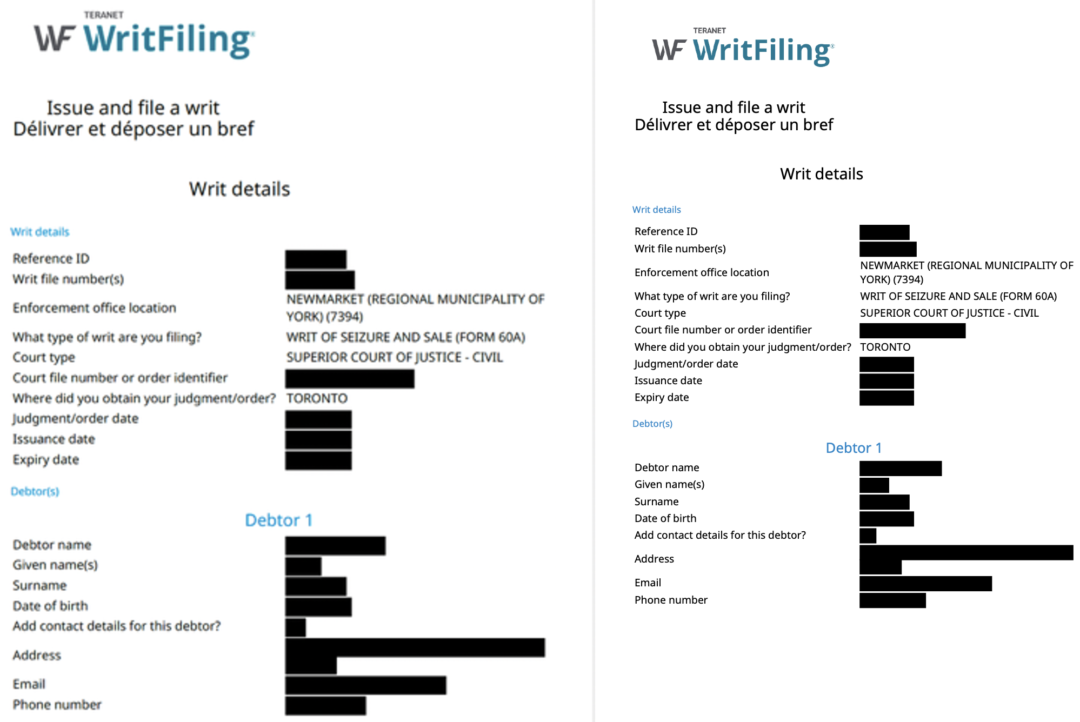
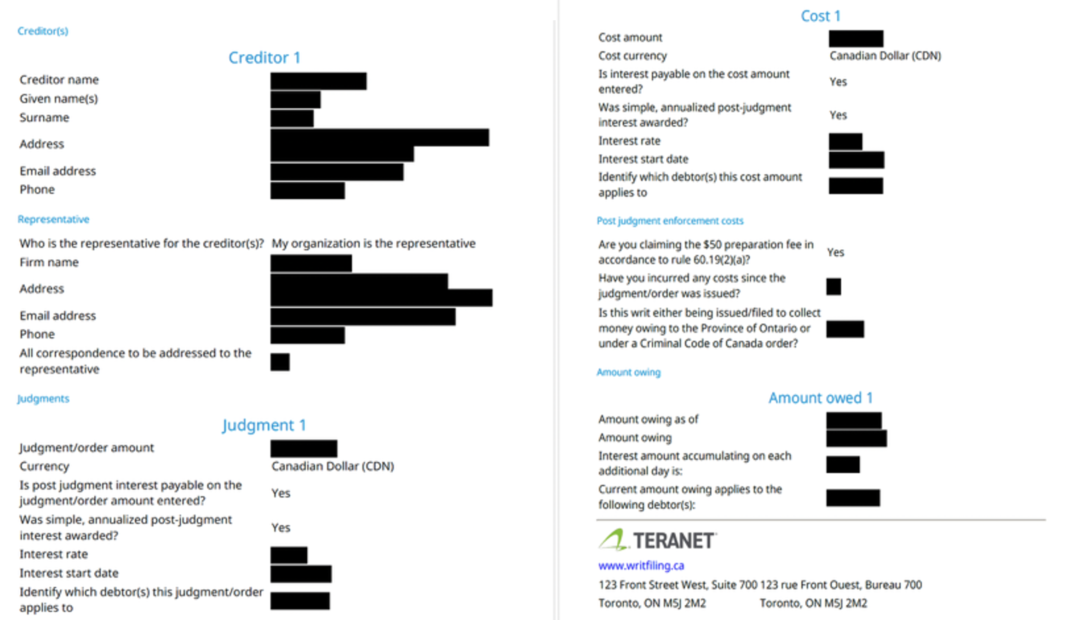
Whether you choose to file the Writ through the court registrar yourself or retain a lawyer to file through WritFiling, understanding the procedural nuances is the key to successfully enforcing the Judgment and collecting the debts. In my next blog, we will dive deeper into the next phase: how to direct the Sheriff to enforce your issued Writ.
Jennifer Jiang
Nothing contained in this post constitutes legal advice or establishes a solicitor-client relationship. If you have any questions regarding your legal rights or legal obligations, you should consult a lawyer.
[1] Rules of Civil Procedure, R.R.O. 1990, Regulation 194 [“Rules”], Rule 60.07(1).
[2] ibid
[3] Ibid at Rule 60.07 (5.1)
[4] “Teranet WritFling Solution Expands Services to Offer Convenience and Facilitate Collaboration.” Teranet, November 23, 2020, Online: <https://www.teranet.ca/insights/teranet-writfiling-solution-expands-services-to-offer-convenience-and-facilitate-collaboration/>
[5] Supra at Rule 60.07(0.1)
[6] Rules, Rule 60.07(1.1)
[7] Ibid at Rule 60.07(1.3); “How do I file/issue or file a writ?”, WritFiling, Online:<https://www.onwrits.ca/en/help-support/support/faq/issue-file-a-writ/how-do-i-file-issue-or-file-a-writ/>
