Mar 11, 2026
A judgment has been awarded to you, but the money hasn’t arrived, yet. We’ve discussed the option of Garnishment in my previous blog. You probably have also heard of a Writ of Seizure and Sale, but how to start the process? Does it have to be filed at the Sheriff’s Office? Did you also accidentally call the York regional police for a sheriff? Oops! Fortunately, there is a new route to have a Writ issued electronically via WritFiling. We will walk you through both options.
Issuance Through the Registrar
A creditor can submit a Writ of Seizure and Sale (Form 60A) (“Writ”) to be issued with a Requisition form at the court registrar where the original proceeding commenced[1].
The Requisition form should detail the date and the amount of payment received, the amount owing, and the rate of post-judgement interest[2]. A copy of the Order should be attached to the Requisition form.
Once a Writ is issued, it may be filed with a Sheriff[3]. The Sheriff’s office is the Enforcement office of the Superior Court of Justice (NOT the police office!)
While the Writ should be issued where the Judgment was granted, it must be filed at the Enforcement office in the region where the debtor lives or owns assets. For example, if your judgment is issued in Toronto and the debtor lives in Richmond Hill. The Writ should be issued in Toronto, but the issued Writ is to be filed at the Sheriff’s Office in Newmarket court.
You may locate the Enforcement office through the following website: https://www.onwrits.ca/en/enforcement-offices/.
For Writ of Seizure and Sale of a property, the Writ should include a legal description of the real property, which can be found in the parcel register. Check out my previous blog: a walk through of the parcel register.
Issuance Through the WritFiling
During the Covid-19 pandemic, technology streamlined the process for legal professionals to issue and file Writs remotely[4].
An authorized user such as a lawyer or a paralegal[5] (for Form 20D: Writ of Seizure and Sale of Land only) may electronically issue the Writ through WritFiling, a product of Teranet software, instead of filing through registrar and enforcement office[6]. An electronically issued Writ is considered to have been both issued by the court and filed with the Sheriff[7].
To use this service, authorized users may submit an application and will receive a secure token. WritFiling has very detailed user guide on application and how to file and issue a Writ.
The filing process is very straightforward, and the issued Writ is designed to be clear and easy to understand. A service fee of $34.95 plus HST will be applied each time. Below is a sample of an electronically issued Writ of Seizure and Sale for your reference.
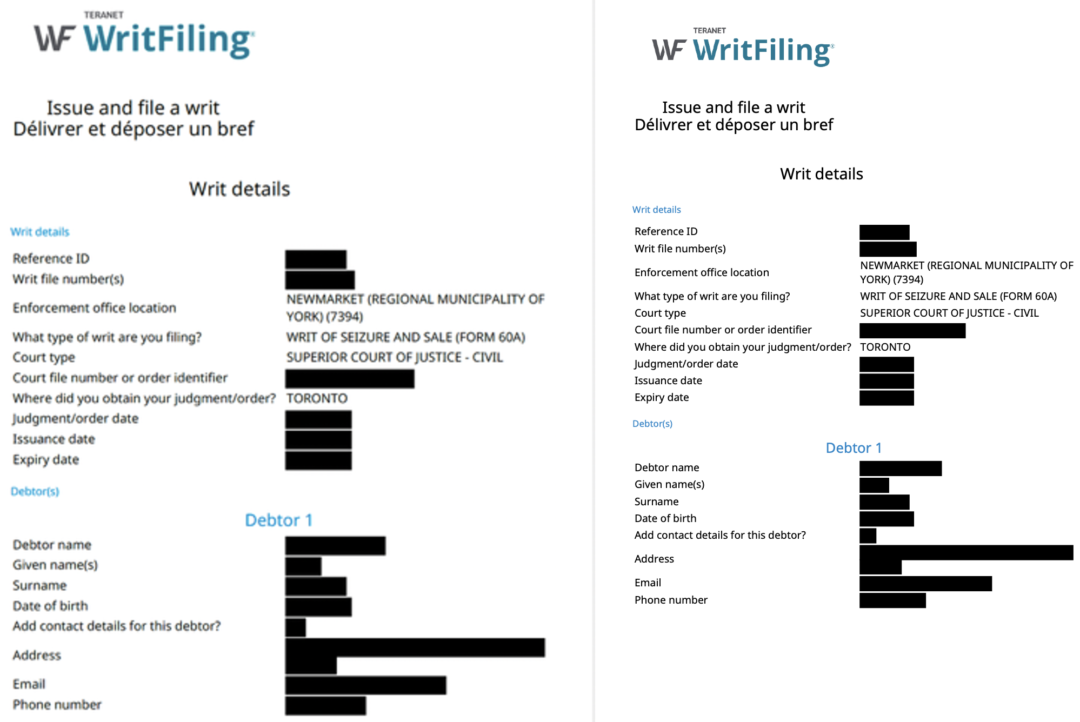
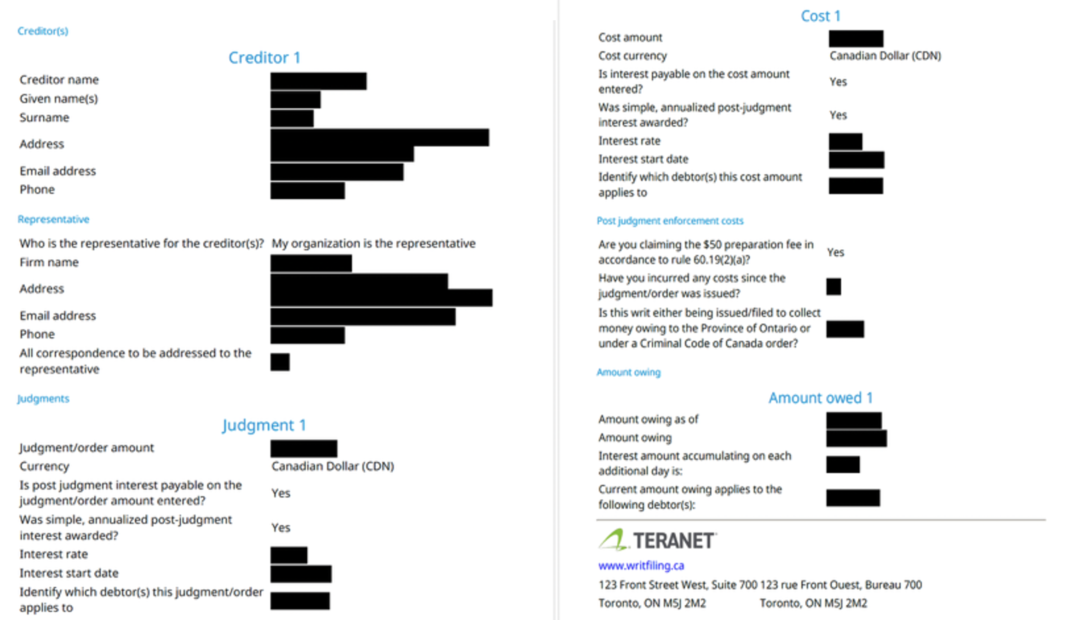
Whether you choose to file the Writ through the court registrar yourself or retain a lawyer to file through WritFiling, understanding the procedural nuances is the key to successfully enforcing the Judgment and collecting the debts. In my next blog, we will dive deeper into the next phase: how to direct the Sheriff to enforce your issued Writ.
Jennifer Jiang
Nothing contained in this post constitutes legal advice or establishes a solicitor-client relationship. If you have any questions regarding your legal rights or legal obligations, you should consult a lawyer.
[1] Rules of Civil Procedure, R.R.O. 1990, Regulation 194 [“Rules”], Rule 60.07(1).
[2] ibid
[3] Ibid at Rule 60.07 (5.1)
[4] “Teranet WritFling Solution Expands Services to Offer Convenience and Facilitate Collaboration.” Teranet, November 23, 2020, Online: <https://www.teranet.ca/insights/teranet-writfiling-solution-expands-services-to-offer-convenience-and-facilitate-collaboration/>
[5] Supra at Rule 60.07(0.1)
[6] Rules, Rule 60.07(1.1)
[7] Ibid at Rule 60.07(1.3); “How do I file/issue or file a writ?”, WritFiling, Online:<https://www.onwrits.ca/en/help-support/support/faq/issue-file-a-writ/how-do-i-file-issue-or-file-a-writ/>
Jan 30, 2026
I’ve recently become a big fan of the British drama Downton Abbey which ran for six series (or ‘seasons’ for us North American folk) from 2010 to 2015, plus five Christmas specials and three feature films. The show centres around an aristocratic English family in the early 20th century who live in the fictional Yorkshire estate of Downton.
The premise of the first series is that Robert Crawley (the Earl of Grantham and the holder of the entail – or life tenancy – that consists of the Downton estate) and his wife have three daughters but no sons. The problem with the entail is that only male heirs could inherit. Thus, Robert’s eldest daughter Mary could never inherit the Downton estate. [Warning: series 3 and 4 spoilers ahead!]
Through a series of events, it was discovered that Robert’s distant cousin Matthew Crawley was the heir presumptive to the entail. Matthew would inherit the entail after Robert’s death and become the next Earl of Grantham. As TV dramas go, Mary and Matthew end up falling in love and marrying. Then, Robert falls into financial trouble and Matthew bails him out by purchasing half of Robert’s life interest in Downton. This gave Matthew control over Downton during Robert’s lifetime. When Robert died, Matthew would become the Earl of Grantham and inherit the whole entail.
Sadly, Matthew dies prematurely in a tragic car accident, with his widow Mary and newborn son George as his survivors. We learn that Matthew died without a will. (Side note, Matthew was a solicitor and didn’t make a will. Tsk.) Since he died intestate, his infant son inherited Matthew’s estate, which included the one-half ownership in Robert’s life interest of Downton.
Robert unilaterally decided that he should be the guardian of George’s share in Downton until he turned 18, probably so that he could take back full control of Downton. Mary objects to that plan and puts herself forward to be the guardian. Family tension! Drama!
It is later discovered that Matthew wrote a letter to Mary and put it in a book in his office just days before he died, which purported to leave his entire estate to her:
My darling Mary,
We are off to Duneagle in the morning and I have suddenly realised that I’ve never made a will or anything like one, which seems pretty feeble for a lawyer and you being pregnant makes it even more irresponsible. I’ll do it properly when I get back and tear this up before you ever see it, but I’ll feel easier that I’ve recorded on paper that I wish you to be my sole heiress. I cannot know if our baby is a boy or a girl but I do know it will be a baby. If anything happens to me before I’ve drawn up a will and so you must take charge. And now I shall sign this and get off home for dinner with you. What a lovely, lovely thought.
Matthew
[Author’s note: WHY would Matthew leave the letter in a book? WHY didn’t he give it to her or put it somewhere more conspicuous? This is pretty bad estate planning for a solicitor.]
The letter was witnessed by two of Matthew’s clients.
Gasp! Is this Matthew’s Last Will and Testament?
Robert’s lawyer investigates, and concludes that Matthew’s letter demonstrates testamentary intention and therefore is upheld as his Last Will and Testament. So, Mary owns half of the Downton estate while Robert’s alive! All’s well that ends well.
Now that I’ve given you a comprehensive play by play of the juicy drama, let’s apply it to modern-day Ontario law.
Intestate Succession
If Mary and Matthew were a married couple with a child in Ontario, would their child inherit the entirety of Matthew’s estate if he died without a will?
Short answer: No. Intestate succession is governed by the Succession Law Reform Act. It provides that where the testator was survived by a spouse and one child, the spouse is entitled to the preferential share of the estate, which is currently prescribed by legislation as $300,000. After payment of the preferential share, the residue of the estate is split into two parts, one for each of the spouse and the child.
For illustrative purposes, let’s say Matthew’s estate was worth $500,000. Mary would get the first $300,000, and the remaining $200,000 would be split equally between Mary and George. Mary would end up with $400,000, and George would get $100,000.
Guardianship of Property of Minors
If George were a baby in Ontario and suddenly inherited money from his deceased father’s estate, could his grandfather Robert or mother Mary simply assume the role as the guardian of George’s property?
Short answer: No. Neither Mary nor Robert can simply assume the role as guardian of George’s property. Assuming that Matthew died intestate, George’s inheritance would have to be paid to the Accountant of the Superior Court of Justice to be held in trust and managed on his behalf until he turned 18 years old. The alternative is for Robert or Mary to apply for guardianship of George’s property under the Children’s Law Reform Act. If guardianship were granted, they would be responsible for managing George’s property pursuant to a court-approved management plan until he turns 18 years old.
Formalities of a Will
Is Matthew’s letter a valid will under Ontario laws?
Short answer: Likely yes. The Succession Law Reform Act requires that wills be in writing, signed by the testator at its end, and witnessed by two witnesses. Testators can also make a holograph will by writing the whole will in his own handwriting and signature, without the requirement of witnessing signatures.
Assuming that there was no dispute that Matthew handwrote the letter and signed it at the end, and since he stated his testamentary intention to dispose of his property by bequeathing his estate to Mary, the letter would likely be upheld as a valid holograph will. The two witness signatures are nice to have but not required, since the letter was written wholly in Matthew’s handwriting.
I have yet to finish the entire show so please no spoilers for series 5, 6, or the films!
Zara Wong
Nothing contained in this post constitutes legal advice or establishes a solicitor-client relationship. If you have any questions regarding your legal rights or legal obligations, you should consult a lawyer.
Jan 23, 2026
Dealing with estates involves more than Wills, probate and distribution. It also includes the emotional challenges families face in coping with loss, especially in sudden deaths.
No one is fully prepared for loss, even if the deceased was ill for an extended time. However, the deceased preparing and providing instructions can certainly assist the family.
Here are some suggestions to help your family navigate estate matters.
Wills
Inform your family that you have made a Will if you have one. Sometimes families are unaware of the existence of a Will and this can lead to time-consuming searches. There are instances where family members discover the Will a year or two later.
You should also consider discussing the Will’s contents with your family to avoid potential disputes or objections during probate. Quite often, equalization arises when spouses feel they are entitled to more than their allocated percentage, while some children may believe they had contributed more to their parent’s well-being and should therefore receive a larger share.
If you do not have a Will, you should strongly consider making one.
Assets
Make a list of your assets and store it in a safe location for easy retrieval. The list of your assets should include, but are not limited to, bank accounts, shares and investments, personal effects, and real property.
Estate trustees and family members often encounter difficulties in locating assets. Contacting financial institutions and enquiring about potential assets and investments left by the deceased can be costly and again time-consuming.
Health
While some individuals may prefer to keep their health concerns private from their families, it is advisable to disclose them. This ensures that in the event of an emergency or sudden passing, their loved ones are not taken by surprise.
If you are hesitant to share this information with your family, at least confide in a trusted family friend and seek their support for the family when needed.
It is also wise to discuss your future healthcare needs and wishes, particularly when you may lose the ability to make decisions for yourself. If you do not have one, you should strongly consider establishing a power of attorney for personal care.
Funeral Arrangements and Burial
Have a family discussion regarding burial preferences. Families often experience emotional distress and confusion during the period immediately after a death and disagreements on this issue can lead to family discord. Leaving clear instructions will prevent this problem.
Legal Representation
It is advisable to retain a lawyer to advise you on Wills, probate and estate-related legal issues.
Casey and Moss is committed to providing quality service with respect to estate matters.
Roslyn Blackette
Nothing contained in this post constitutes legal advice or establishes a solicitor-client relationship. If you have any questions regarding your legal rights or legal obligations, you should consult a lawyer.
Nov 20, 2025
Each time a new matter is commenced with the Superior Court of Justice (“SCJ”), you are provided with a unique court file number. There are two main formats in which the SCJ has issued court file numbers (“CFN”), which in this blog I will refer to as the “old” and “new” formats.
The old CFN format is as follows: _ _ – _ _ _ / _ _. The first five digits represent the court’s internal case or file number. The last two digits represent the year in which the CFN was issued. For example, if your CFN was issued in 2025, it would read _ _ – _ _ _ / 25.
The new CFN format is as follows: CV -_ _ – _ _ _ _ _ _ _ _ – 00ES (or 0000). The first two digits represent the year in which the CFN was issued. For example, if your CFN was issued in 2025, it would read CV-25-_ _ _ _ _ _ _ _ -00ES (or 0000). The next eight digits represent the court’s internal case or file number. The final four digits are an extension and will always either be 00ES or 0000. The first, 00ES, is used only by the Toronto Estates Court, which is a division of Toronto Superior Court of Justice. The second, 0000, is more commonly used by other regions of the Superior Court of Justice.
Oftentimes when you have an older file that is still active, you need to convert the old CFN format to the new one. For instance, when filing materials online, the JSO portal will not accept the old CFN formatting. In this case, you need to do the following:
Old CFN: 01-123-25
New CFN: CV-25-00001123-00ES (or 0000)
- Begin with the prefix ‘CV-‘.
- Take the last two digits of the old CFN and insert it after the ‘CV-‘ in the new CFN. The first two digits will be ‘25’, as this is the year the CFN was issued.
- Take the next five digits of the old CFN and add three zeros in front it. Then, insert these eight digits (i.e., ‘00001123’) into the new CFN after ‘-25-‘.
- If the matter is with the Toronto Estates court, the last four digits of the new CFN will be ‘00ES’, otherwise for civil matters, the last four digits will be ‘0000’.
I hope this proves helpful and takes some of the mystery out of converting old court file numbers!
Hannah Henley
Nothing contained in this post constitutes legal advice or establishes a solicitor-client relationship. If you have any questions regarding your legal rights or legal obligations, you should consult a lawyer.
Nov 4, 2025
The first few months of law school can feel overwhelming. I remember worrying about moving to a new city, establishing friendships, and adapting to a teaching style that was completely different from anything I had experienced before. Adding extracurricular commitments to an already full schedule was the last thing on my mind.
Yet, it felt like everyone around me was enthusiastically joining clubs and activities. Not wanting to get left behind, I somewhat-reluctantly followed suit. Looking back, deciding to get involved was one of the most valuable decisions I made in law school.
Here are some of the benefits:
Networking and Mentorship
Getting involved outside of class gave me plenty of opportunities to meet other students, professors and practicing lawyers. This was a game-changer because I quickly learned that upper-year students are the best resource for outlines, study tips, and advice about second and third-year courses. It was also great to connect with practicing lawyers because they offered firsthand insights into their areas of practice and daily work. Some of these relationships have turned into ongoing support networks that have become a huge asset now that I’ve started my career.
Discovering Different Types of Law
During my second year of law school, I joined the Queen’s Elder Law Clinic (“QELC”) as a student caseworker, where I drafted Wills and Power of Attorney documents for older adults in the Kingston area. This experience introduced me to estate litigation – a field I immediately connected with, and one that I wish had received more attention in my first-year courses. Thanks to this introduction, I applied to (and now work at) Casey & Moss, a firm that exclusively practices in the area of Estates and Trusts. Without my involvement at the QELC, I’m not sure if I would have ended up working in an area that I’m so passionate about.
Developing Practical Skills
During my first year, I spent time mooting (a type of simulated court for students to practice oral advocacy). This provided a fantastic introduction to courtroom procedure, legal research and writing, and developing persuasive oral arguments. At the QELC, I learned essential skills like time docketing, effective client communication, and how to prioritize urgent tasks. These practical abilities made the transition from student to lawyer much smoother and remain integral to my daily work.
Demonstrating Genuine Interest
While interviewing for jobs, I was initially concerned about standing out among other candidates. However, much of my interview time was spent discussing the things I did outside of the classroom. In hindsight, this makes a lot of sense. Law firms, particularly those specializing in niche practice areas, are looking for students who are genuinely interested in the type of law they practice. Participating in related clubs, clinics, and moots is one of the best ways to display an authentic interest in a given field.
Getting involved in law school helps you build skills, meet people, and find out what really interests you. Even if it feels overwhelming at first, the connections and experiences you gain will stick with you well beyond graduation and can make a big difference as you start your career.
Colleen Dowling
Nothing contained in this post constitutes legal advice or establishes a solicitor-client relationship. If you have any questions regarding your legal rights or legal obligations, you should consult a lawyer.
